
23 Apr
2026
23 Apr
'26
4:42 p.m.
<<english below>>
Liebe Kolleg:innen,
Wir möchten Sie herzlich zu dem ersten Gastvortrag + anschließendem
Workshop der Reihe „Werkstatt Phänomenologie“ einladen.
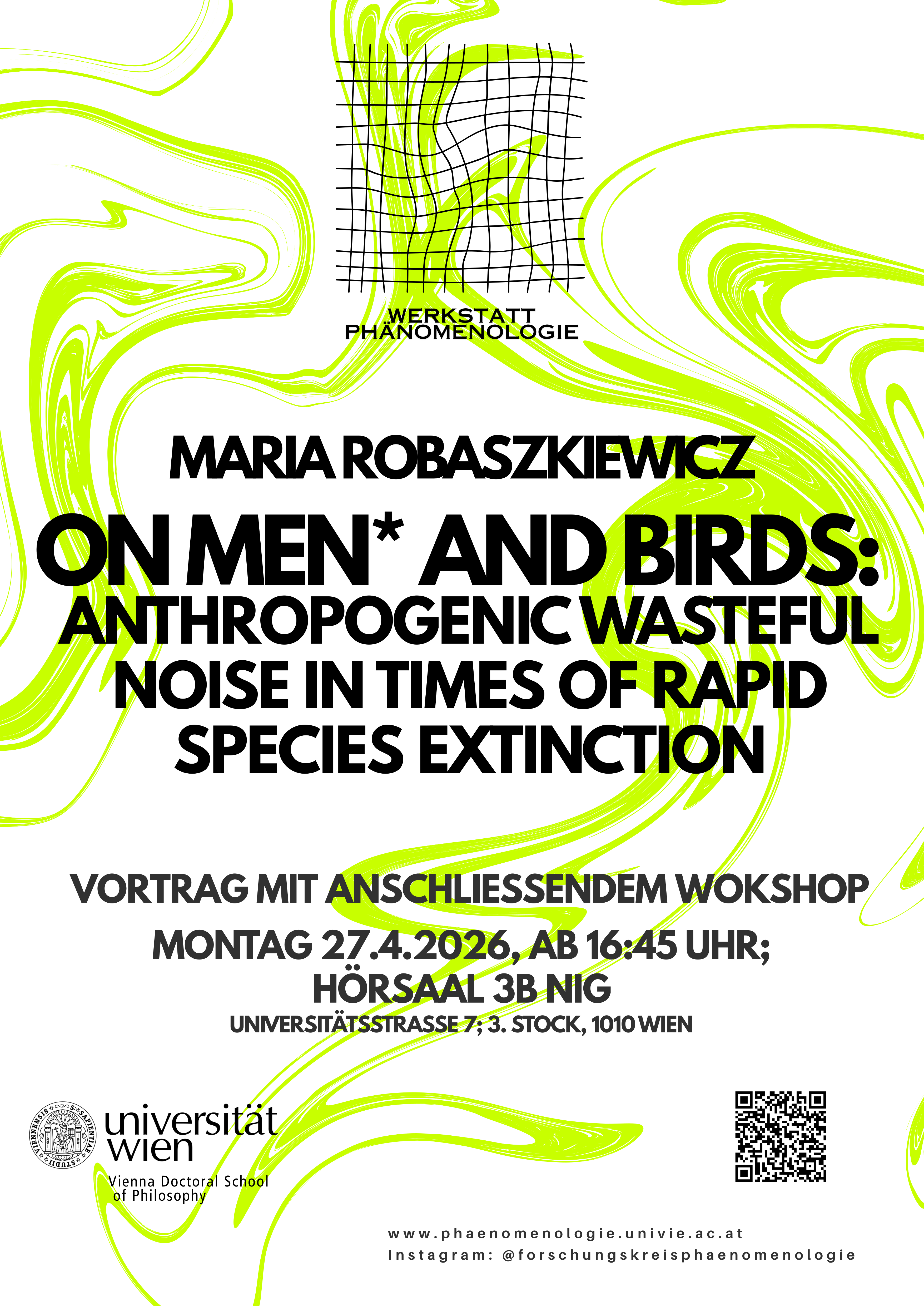
Montag, *27.4.2026*, um *16:45*, Hörsaal 3B im NIG:Maria Robaszkiewicz - On
Men* and Birds: Anthropogenic Wasteful Noise in Times of Rapid Species
Extinction
Der anschließende Workshop widmet sich dem Thema Migration. Texte dafür
finden Sie auf unserem Moodle, für den Sie sich hier
<https://phaenomenologie.univie.ac.at/forschung/newslettermoodle/> einschreiben
können.
Weitere Informationen zu Veranstaltungen der Werkstatt Phänomenologie
finden Sie auf unserer Website
<https://phaenomenologie.univie.ac.at/forschung/werkstatt-phaenomenologie/>
sowie auf Instagram
<https://www.instagram.com/forschungskreisphaenomenologie/>.
Mit besten Grüßen,
Team Werkstatt Phänomenologie
<<english>>
Dear colleagues,
We would like to warmly invite you to the first guest lecture followed by a
workshop in the “Werkstatt Phänomenologie” series.
*Monday, 27 April 2026, at 16:45, Lecture Hall 3B at the NIG:*
Maria Robaszkiewicz – On Men* and Birds: Anthropogenic Wasteful Noise in
Times of Rapid Species Extinction
The subsequent workshop will focus on the topic of migration. You can find
the relevant texts on our Moodle, where you can also enroll here
<https://phaenomenologie.univie.ac.at/forschung/newslettermoodle/>.
Further information about events in the Werkstatt Phänomenologie series can
be found on our website
<https://phaenomenologie.univie.ac.at/forschung/werkstatt-phaenomenologie/>
as well as on Instagram
<https://www.instagram.com/forschungskreisphaenomenologie/>.
With best regards,
The Werkstatt Phänomenologie team
[image: MARIA ROBASZKIEWICZ_27.4.36.png]
Abstract:
There is always a certain purposefulness of natural sounds: the sound of
breaking waves manifest the conditions on the sea, the sound of striking
thunder marks the dangers of a storm, birds’ singing is their way of
communication. These sounds make worldly sense as they inform all
perceptible beings about their surroundings, about the momentary conditions
of the world. Accordingly, sounds of nature are limited in scope (an
assertion that may be challenged by environments such as native jungle,
though a different register of perception could be expected there), to the
extent that when we happen to be in spaces empty of anthropogenic sounds,
our experience might be very close to an experience of silence.
Humans, on the contrary, produce a lot of noise polluting our earthly
surroundings. This noise is often wasteful; it doesn’t communicate anything
specific that we need for a better orientation in the world. Continuous
passing of cars in front of my window, the monotonous noise of a machine,
the drilling and hammering of endless construction sites consume time
repeating the same futile message over and over again.
In Anthropocene, it is not only noise that is wasteful this way: it’s also
light, energy water or oxygen. Through the continuous decrease of,
especially animal, diversity, human noise becomes hegemonial. In urban
spaces, the declining presence of singing, cawing and quacking birds
constitutes perhaps the most noticeable change in this respect, one of the
reasons for which is anthropogenic harm to birds’ migratory routes.
I argue that phenomenology as an attentive style of thinking helps us to
notice the scale of the problem, which is the condition of possibility for
action and change. In doing this, I reach to different ecophenomenological
readings of Merleau-Ponty, ecophenomenologies of sound, and descriptive
studies of birds’ migration.
179
days inactive
179
days old
0 comments
1 participants
participants (1)
-
 Georg Harfensteller